( 3. )
( 3. )
( 3. )
Trial to Value
Driving activation and monetisation across Deskpro
Improved trial activation and monetisation by guiding users to experience product value earlier, increasing first session duration by 16%.

Improved trial activation and monetisation by guiding users to experience product value earlier, increasing first session duration by 16%.
Deskpro was growing, but trial engagement and conversion weren’t keeping pace. Users entered a complex product with little guidance, often exploring briefly without understanding its core value.
I redesigned the journey from first interaction to upgrade, helping users reach meaningful outcomes earlier and make more confident decisions.
Led to deeper engagement, clearer upgrade pathways, and stronger alignment between product experience and monetisation.
Deskpro was growing, but trial engagement and conversion weren’t keeping pace. Users entered a complex product with little guidance, often exploring briefly without understanding its core value.
I redesigned the journey from first interaction to upgrade, helping users reach meaningful outcomes earlier and make more confident decisions.
Led to deeper engagement, clearer upgrade pathways, and stronger alignment between product experience and monetisation.
Team
Sales,
Product,
Marketing,
Engineering,
Customer Success
Role
Product Design,
Prototyping,
Strategy
Year
2024-25


Problem
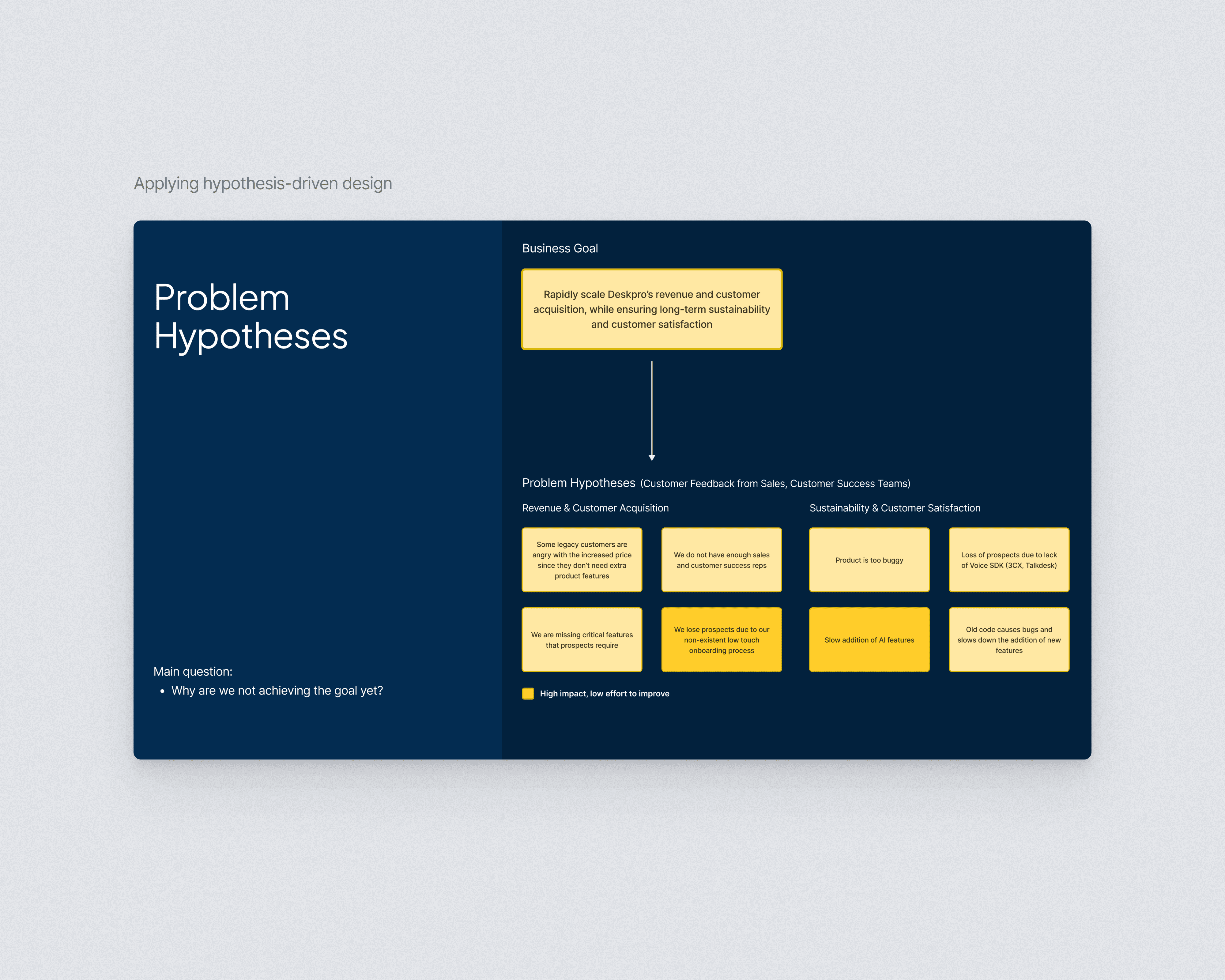
New users were dropped into a complex product without a clear path to value. They explored briefly, but often failed to reach meaningful outcomes or understand its value.
At the same time, AI features were becoming central to the commercial proposition, but users were not consistently experiencing them in practice.
This created a gap between product capability and user understanding, limiting both engagement and conversion.
New users were dropped into a complex product without a clear path to value. They explored briefly, but often failed to reach meaningful outcomes or understand its value.
At the same time, AI features were becoming central to the commercial proposition, but users were not consistently experiencing them in practice.
This created a gap between product capability and user understanding, limiting both engagement and conversion.

Approach
The issue wasn’t a lack of features or demand, but how the product was experienced.
Users needed to reach a meaningful outcome quickly, understand its value, and decide whether it was worth paying for. Instead, evaluation was slow and uncertain.
I reframed this as a funnel problem, focusing on how users move from first interaction to paid adoption.
I focused on key moments where clarity and guidance unlock value, leading to three targeted interventions across activation, monetisation, and decision-making.
The issue wasn’t a lack of features or demand, but how the product was experienced.
Users needed to reach a meaningful outcome quickly, understand its value, and decide whether it was worth paying for. Instead, evaluation was slow and uncertain.
I reframed this as a funnel problem, focusing on how users move from first interaction to paid adoption.
I focused on key moments where clarity and guidance unlock value, leading to three targeted interventions across activation, monetisation, and decision-making.

Activation — Agent Guide
The clearest gap was at the start of the trial. Users entered the agent interface without knowing what to do next, leading to shallow exploration and early abandonment.
I identified core workflows and structured onboarding around them using a checklist-based experience, guiding users through real actions. Each step triggered contextual, in-product guidance.
After launch, onboarding completion reached 82% for the first step and first session duration increased by 16%, with 141 onboarding interactions in the first 30 days.
This shifted users from passive exploration to completing meaningful actions early in the trial, creating a foundation for deeper engagement.
The clearest gap was at the start of the trial. Users entered the agent interface without knowing what to do next, leading to shallow exploration and early abandonment.
I identified core workflows and structured onboarding around them using a checklist-based experience, guiding users through real actions. Each step triggered contextual, in-product guidance.
After launch, onboarding completion reached 82% for the first step and first session duration increased by 16%, with 141 onboarding interactions in the first 30 days.
This shifted users from passive exploration to completing meaningful actions early in the trial, creating a foundation for deeper engagement.


Monetisation — Making AI Value Tangible
Once users were reaching meaningful outcomes, the next challenge was making the value of AI tangible.
AI was central to Deskpro’s proposition, but users were not consistently reaching moments where it became relevant.
I introduced a credits-based system that allowed trial users to experiment with AI features in a controlled way, making the capability concrete while reinforcing its role in paid plans.
I also aligned setup and upsell flows with moments where users had already seen results, grounding upgrade decisions in product experience rather than interruption.
This connected product experience directly to monetisation, making upgrades a natural continuation of use.
Once users were reaching meaningful outcomes, the next challenge was making the value of AI tangible.
AI was central to Deskpro’s proposition, but users were not consistently reaching moments where it became relevant.
I introduced a credits-based system that allowed trial users to experiment with AI features in a controlled way, making the capability concrete while reinforcing its role in paid plans.
I also aligned setup and upsell flows with moments where users had already seen results, grounding upgrade decisions in product experience rather than interruption.
This connected product experience directly to monetisation, making upgrades a natural continuation of use.

Acquisition & Billing — Clarifying Decisions
The final step was reducing friction at key decision points.
On the landing page, I brought the product interface above the fold to reduce drop-off.
Within the product, I designed a billing dashboard to clarify plans, usage, and account status, helping users understand their options and act confidently.
This reduced uncertainty and completed the journey from discovery to conversion.
The final step was reducing friction at key decision points.
On the landing page, I brought the product interface above the fold to reduce drop-off.
Within the product, I designed a billing dashboard to clarify plans, usage, and account status, helping users understand their options and act confidently.
This reduced uncertainty and completed the journey from discovery to conversion.


Outcome
The Agent Guide delivered the clearest measurable impact, with first session duration increasing by 16% and first step onboarding completion reaching 82%.
More broadly, the work improved how users understood the product, clarified upgrade pathways, and created a more predictable journey from trial to paid.
It also established a foundation for aligning product experience with monetisation, ensuring users encounter value before being asked to upgrade.
The Agent Guide delivered the clearest measurable impact, with first session duration increasing by 16% and first step onboarding completion reaching 82%.
More broadly, the work improved how users understood the product, clarified upgrade pathways, and created a more predictable journey from trial to paid.
It also established a foundation for aligning product experience with monetisation, ensuring users encounter value before being asked to upgrade.
Reflection
This work shifted my focus from designing features to designing behaviour. I looked beyond individual surfaces to how users move through the product, what they need to understand, and what enables them to move forward.
It reinforced that monetisation is not just about pricing or prompts, but about when and how users recognise value, so that upgrading feels like a natural continuation of use.
This work shifted my focus from designing features to designing behaviour. I looked beyond individual surfaces to how users move through the product, what they need to understand, and what enables them to move forward.
It reinforced that monetisation is not just about pricing or prompts, but about when and how users recognise value, so that upgrading feels like a natural continuation of use.
← previous
( 2. )
next →
( 4. )